
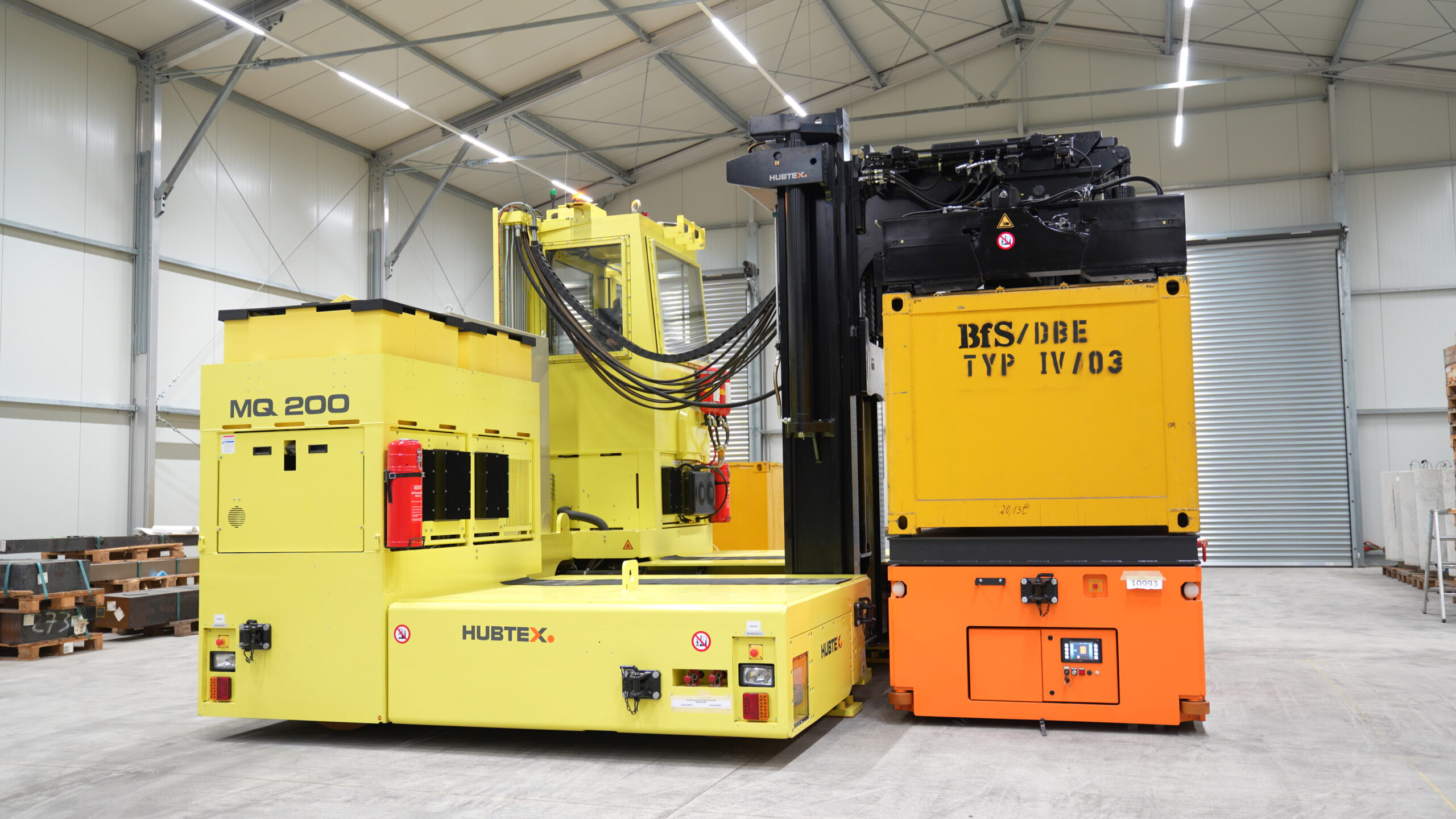
Hubtex is developing five specialised vehicle types for Germany’s Konrad repository, where low- and intermediate-level radioactive waste will be handled at a depth of about 850 metres. The fleet will cover a connected sequence of above-ground handling, transport, transfer and accurate positioning underground.
The vehicles will also move fresh concrete and pump-delivered concrete used to backfill storage areas. Larger units will be dismantled before entering the underground facility and reassembled there, while their inspection and technical records remain continuous.
The project required a bespoke approach because standard vehicles could not combine narrow routes, gradients, heavy loads and defined transfer procedures with the required safety controls. The design also addresses radiation protection, decontamination, fire risks, collision avoidance, fall hazards and operator protection.
Following an analysis of routes, interfaces, loads, environmental conditions and hazards, Hubtex developed coordinated chassis, steering, lifting and protection concepts. Depending on their role, the vehicles can include shielded cabins with lead glass and steel walls, protected ventilation, fire detection and suppression, emergency steering, positioning technology, optical guidance, load tracking and communications.
The programme is centred on interaction between vehicle types at designated handover points. Hubtex is therefore integrating mechanical systems, protection measures, transfer operations and process monitoring rather than treating each machine as a standalone product.
Quality assurance runs throughout design and production. Drawings, calculations and inspection plans define the required build and test regime, while changes must be assessed and approved. Materials, welds, assemblies and installations are checked during manufacture, with BGE representatives and an independent expert involved at relevant stages. Welding qualifications and non-destructive testing add further verification for specialised materials and critical joints.

A multilingual professional experienced in Europe, Canada, and China, Herbert has developed invaluable networks in the automotive and energy industries. He has led high-profile projects involving ENBW, Mercedes-Benz Group, Siemens Group, and the Fraunhofer Institute.