

Industrial label printing is becoming a broader operational issue as warehouses manage more systems, data and compliance requirements. The printer remains important, but the surrounding software and integration capabilities increasingly determine how easily a site can respond to change.
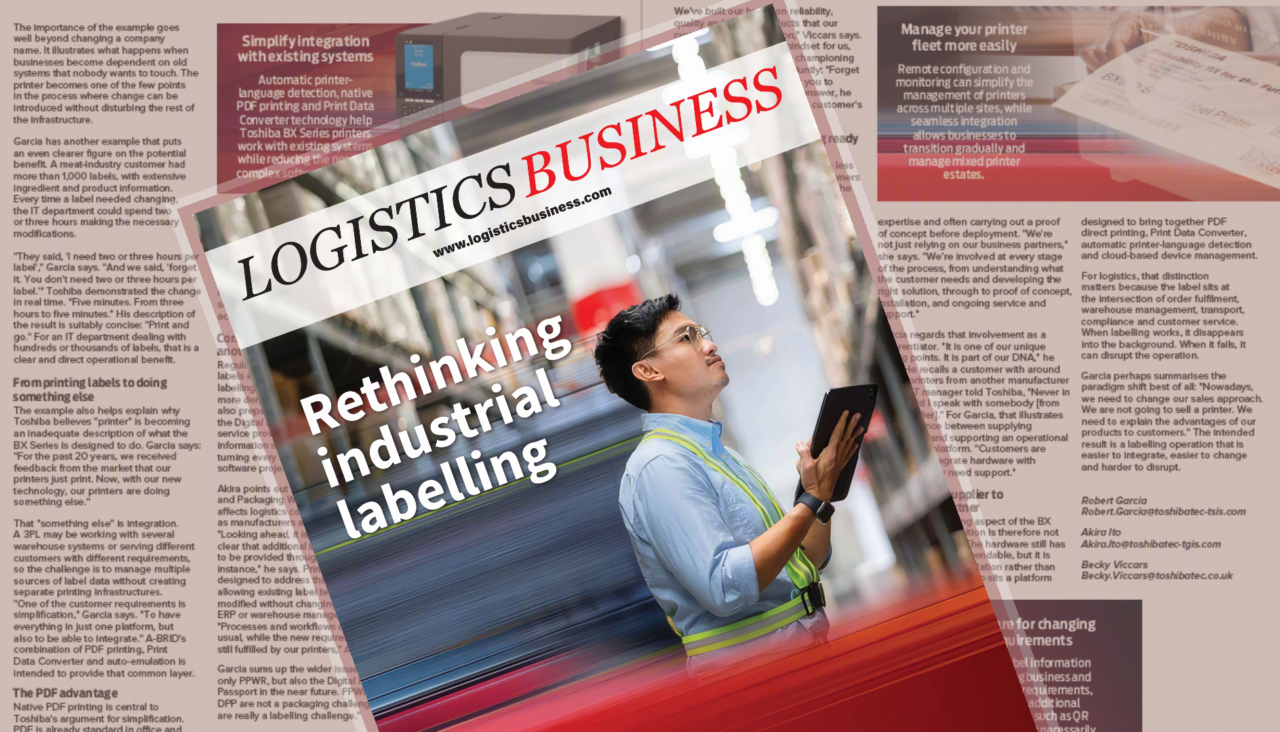
A new eBook, Rethinking Industrial Labelling, produced with Toshiba Tec, reviews developments in the sector. Peter MacLeod of Logistics Business speaks with Toshiba Tec experts about native PDF printing, automatic printer-language detection and approaches to simpler system integration.
The publication also highlights the potential business impact. One example records a reduction in label-change time from as much as three hours to five minutes. In suitable applications, another technology discussed in the eBook could reduce ribbon consumption by up to 75%.
For warehouse operators, these capabilities may help limit configuration effort, accelerate responses to changing requirements and reduce consumable usage. Their value will depend on the individual workflow, but the direction is clear: labelling is increasingly being considered as part of the warehouse technology stack rather than as a standalone hardware purchase.
That shift gives industrial companies a wider set of criteria when reviewing printing infrastructure. Reliability and speed remain essential, but flexibility, compatibility and the cost of ongoing change are becoming equally relevant to operational performance.