
Artificial intelligence is becoming an operational technology in warehousing, rather than a tool confined to trials. Gartner points to labour shortages, lower-risk routes into automation and improving AI maturity as the main forces behind adoption.
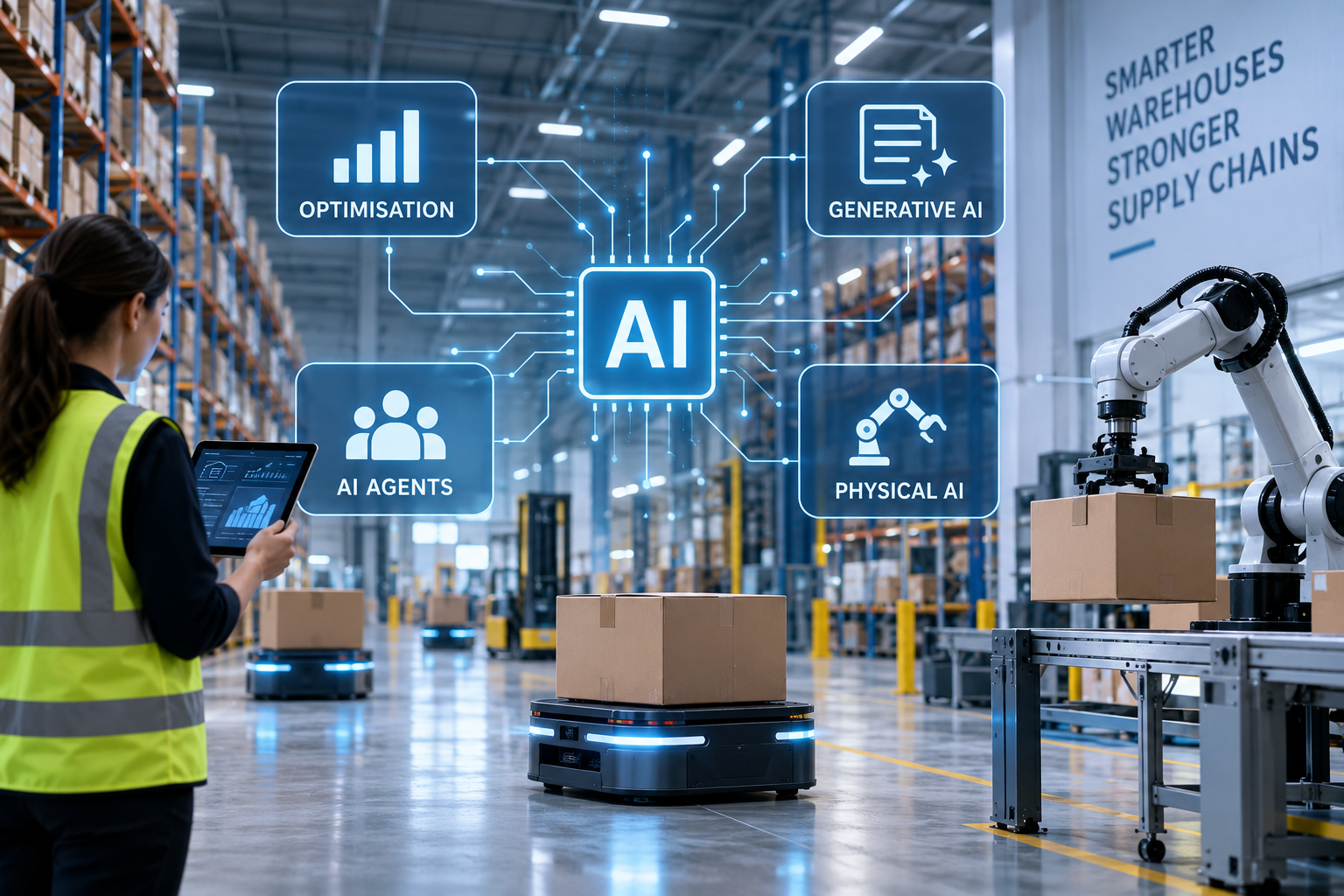
Its first identified trend is more adaptive optimisation. Forecasting, labour planning, route management and inventory systems can use richer real-time data to revise recommendations as warehouse conditions change. The objective is better use of resources without losing the transparency and repeatability expected from established planning tools.
The second trend is generative AI embedded in warehouse work. Models can convert unstructured or partly structured information into operating procedures, instructions, exception responses and decision support. This places generative capabilities inside workflows rather than treating them as a separate layer.
Suggestive and semi-autonomous agents form a third stage. They can analyse operations, recommend multistep actions and execute selected elements while people retain oversight. Task allocation, exception handling and resource decisions are among the possible uses.
The final trend is physical AI, combining software, robotics and sensing to perform picking, packing, sorting and material handling. Gartner expects such systems to support throughput, consistency and safety while helping companies manage persistent workforce constraints.
The recommended route is incremental: start with proven use cases such as labour forecasting and slotting, then assess generative AI and agent-based systems. Human supervision and evidence-based performance reviews should remain in place as autonomy expands.

A multilingual professional experienced in Europe, Canada, and China, Herbert has developed invaluable networks in the automotive and energy industries. He has led high-profile projects involving ENBW, Mercedes-Benz Group, Siemens Group, and the Fraunhofer Institute.