
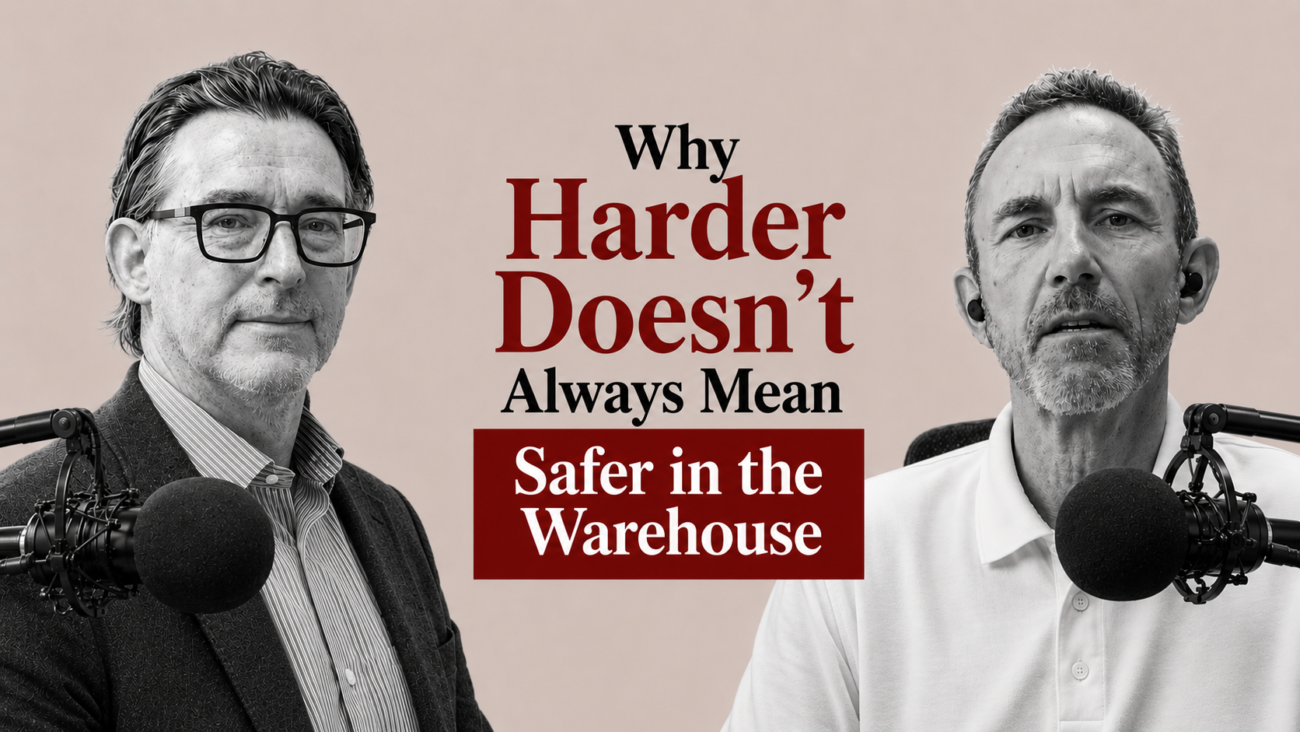
Warehouse operators are being encouraged to look beyond the simple idea that the strongest barrier delivers the safest outcome after a forklift collision. The way impact energy is managed can influence damage to racking, columns, vehicles and surrounding operations.
Jim Ryan, founder of Sentry Protection Products, discussed the issue with Peter MacLeod in Logistics Business Conversations. With nearly 30 years in warehouse protection systems, Ryan highlighted how a collision involving several tonnes of handling equipment can create consequences that are not immediately visible.
A single incident may affect employees, stock, productivity and the availability of a warehouse area, in addition to the directly damaged infrastructure. A highly rigid protection system may not always deliver the expected result if forces are transferred elsewhere in the structure.
The discussion also examined collision-avoidance technology and the implications of autonomous vehicles. As warehouses become more automated, physical protection increasingly forms part of a wider safety system involving vehicles, sensors and operational controls.
For industrial businesses, the practical question is how to reduce the severity of incidents and restore operations quickly. Ryan argues that the most useful solution may not be the most sophisticated one. Technology that is straightforward, properly matched to the environment and maintainable in daily operation can support safety while limiting disruption to throughput.

A multilingual professional experienced in Europe, Canada, and China, Herbert has developed invaluable networks in the automotive and energy industries. He has led high-profile projects involving ENBW, Mercedes-Benz Group, Siemens Group, and the Fraunhofer Institute.