

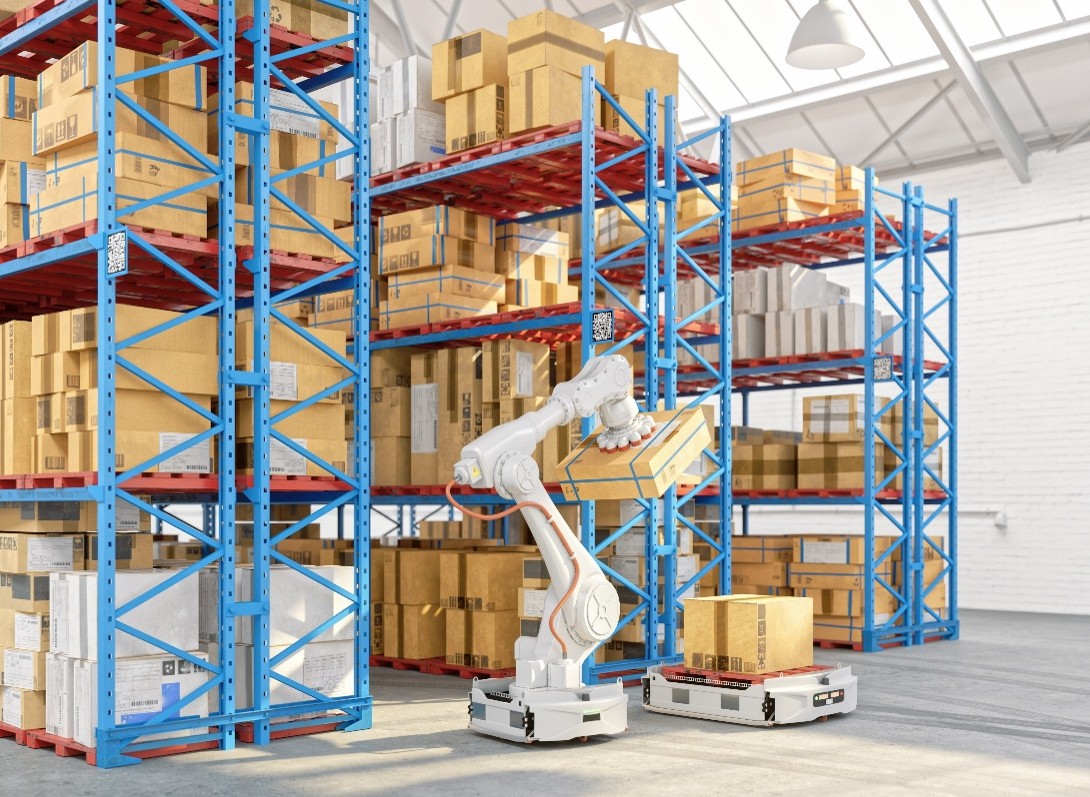
Warehouse automation is moving into a broader range of industrial operations as companies face higher order volumes, more product variety and tighter delivery expectations. The global market is forecast to grow from approximately €21 billion in 2025 to €42 billion by 2030.
Robots are increasingly being used for picking, put-away, depalletising and packing, supported by advances in machine vision, gripping and artificial intelligence. Humanoid systems remain at an early stage, with initial warehouse applications focused on moving cases and transferring goods between equipment.
AI is also helping operators manage more complex fulfilment. Software can determine storage locations, route orders and allocate tasks to robots. In goods-to-person environments, it can sequence retrievals so products arrive at picking stations efficiently.
For existing sites, modular automation offers a route to higher capacity without a complete rebuild. High-density matrix systems, or cubic AS/RS, can be configured for different capacities and integrated with established warehouse equipment. They are suited to high-SKU, lower-load applications, and adoption is estimated to rise by 20–25% over the next five years.
The case for retrofits is strengthened by slower expected growth in warehouse stock, from about 5% annually across Europe, the US and Asia-Pacific in 2020–25 to 3–4% towards 2030. Integrators and platform-independent software providers are consequently becoming more important, linking robots, storage, sortation, conveyors and warehouse control systems.
For operators, the commercial test is the performance of the complete system: higher throughput, better use of space and the flexibility to respond to changing demand. Further analysis is available from L.E.K Consulting.